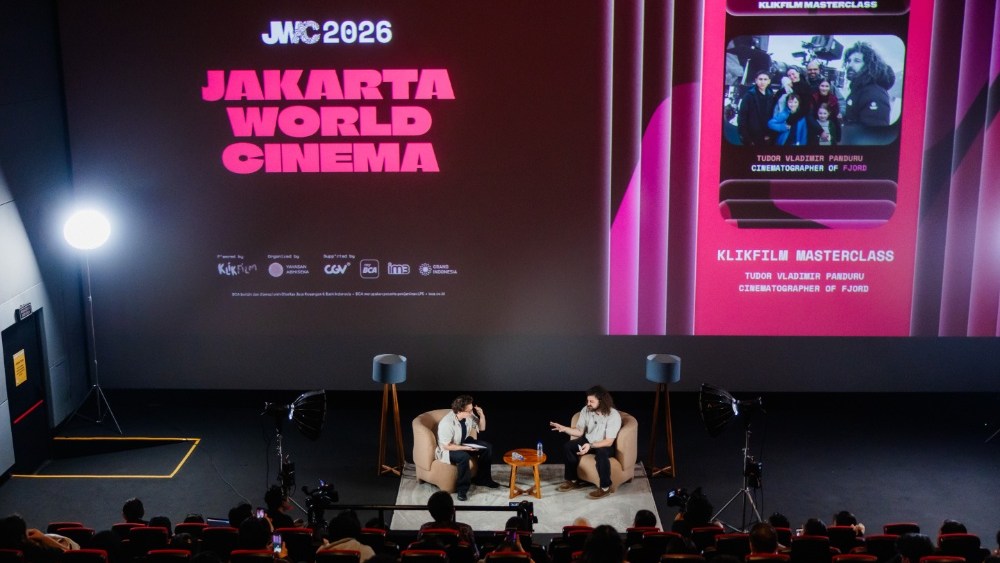
Known for his long-time collaboration with Romanian auteur Cristian Mungiu, cinematographer Tudor Vladimir Panduru shared his experience making “Graduation,” “R.M.N.,” “Fjord” and Iraqi director Hasan Hadi’s “The President’s Cake” during his masterclass at Jakarta World Cinema.
Benh Zeitlin, the Oscar-nominated director of “Beasts of the Southern Wild,” said he was moderating the session because “we hope to work together someday.” He praised Panduru as the kind of cinematographer who could “bring a dimension to your work that is beyond your personal imagination.”
The masterclass traced Panduru’s career chronologically, starting with the screening of one indoor and one outdoor scene from “Graduation.” Panduru trained under Oleg Mutu, Mungiu’s longtime cinematographer on films including “4 Months, 3 Weeks and 2 Days,” and was introduced to the Romanian director while still a trainee. “Graduation” was Panduru’s second film as a cinematographer, but it was also the one that made his name internationally.
Panduru said the camera in Mungiu’s films is meant to stay low-profile and avoid steering the audience toward certain things, because viewers are “smart enough to understand what’s going on there.”
“With Cristian Mungiu’s work, he usually shoots plan-séquence, one scene per shot. There is no editing, no cuts. From a cinematographer’s point of view, things can be quite difficult because we end up shooting a lot of takes, and the performance comes as somehow the most important thing on set,” said Panduru. “We end up shooting 20, 30, 40 takes sometimes to reach the best outcome.”
The grueling repetition of long takes, however, was not as dreary as one might imagine, as Mungiu is able to keep everyone fresh throughout. Panduru also pointed out that the responsibility to stay fresh lies with each individual, since shooting is about living the moment with everyone on set.
“It’s also a matter of trust. When you get to work in this kind of style, everybody gives a bit of himself into that process, so there’s a moment of synchronicity,” he said. “We don’t shoot 30 takes because the takes are not good. [The one that works] needs to have all the elements get together so you have the best outcome of everything.”
Zeitlin said Mungiu’s films value “directness and truthfulness” and criticize “hypocrisy and dishonesty.” Panduru agreed, saying Romanian cinema has often been rooted in social issues and that what Mungiu addresses is important. “I’m just trying to help him tell that,” he said.
On his choice of projects, Panduru said artists should collaborate based on shared values, and that he has been lucky enough to choose the subjects that drew him. He ruled out making an action film, “or maybe only if it’s something that has a social drama behind. Everything relates to affinities.”
During the masterclass, several of Panduru’s defining scenes were screened, each followed by a technical breakdown of how it was shot: the 20-minute take of more than 100 people gathered in the town hall in “R.M.N.,” the long shot alongside a sailing boat on the water in “The President’s Cake,” and two scenes from Mungiu’s latest film, “Fjord.”
The use of light in “R.M.N.” led the discussion, with Panduru revealing that the daytime scene was in fact shot at night. “You’re basically using the focus pulling as a way to edit and also reframe in the same shot without having the camera moving at all,” he said of the hardest part, keeping more than 100 people in focus in a single frame.
Zeitlin said that when he saw the clip from “The President’s Cake,” he realized the same person had shot the Mungiu film. “I was like, I have to talk to the cinematographer,” he said, adding that the film’s aesthetic was distinctly different from Mungiu’s.
Panduru said the film was a children’s fairytale that naturally called for a different visual language. The natural landscape inspired him to build scenes more creatively, freeing him to use running jib arms and wheels, techniques he went on to use again on “Fjord.”
The first clip from “Fjord,” a family gathering that appeared to be shot at “magic hour,” the brief window just before sunset, turned the discussion back to light. Panduru explained how he blocked the natural light from outside to buy more time for the performances.
The masterclass ended with another long take from “Fjord,” in which the camera follows star Renate Reinsve from searching on the ground to jumping into the sea.
“It was really important to have the entire arc of the scene of the emotional trajectory of the characters, [so] it was really important for Cristian not to cut in this moment,” said Panduru.
The cinematographer, who jumped into the freezing sea alongside Reinsve, said he thought that would be the most straightforward way of shooting it, but that the hardest part was synchronizing with the actor mid-jump. “And the second, while I was doing [it], if I lost the camera in the moment of the jump –” he said, as the audience laughed. “I had a really great team of grips who were supporting me in the water and also outside the water.”
PakarPBN
A Private Blog Network (PBN) is a collection of websites that are controlled by a single individual or organization and used primarily to build backlinks to a “money site” in order to influence its ranking in search engines such as Google. The core idea behind a PBN is based on the importance of backlinks in Google’s ranking algorithm. Since Google views backlinks as signals of authority and trust, some website owners attempt to artificially create these signals through a controlled network of sites.
In a typical PBN setup, the owner acquires expired or aged domains that already have existing authority, backlinks, and history. These domains are rebuilt with new content and hosted separately, often using different IP addresses, hosting providers, themes, and ownership details to make them appear unrelated. Within the content published on these sites, links are strategically placed that point to the main website the owner wants to rank higher. By doing this, the owner attempts to pass link equity (also known as “link juice”) from the PBN sites to the target website.
The purpose of a PBN is to give the impression that the target website is naturally earning links from multiple independent sources. If done effectively, this can temporarily improve keyword rankings, increase organic visibility, and drive more traffic from search results.
Streaming Film
Nonton Film gratis
Jasa Backlink
Download Anime Batch

Leave a Reply