Powder aims to feature only the best products and services. If you buy something via one of our links, we may earn a commission.
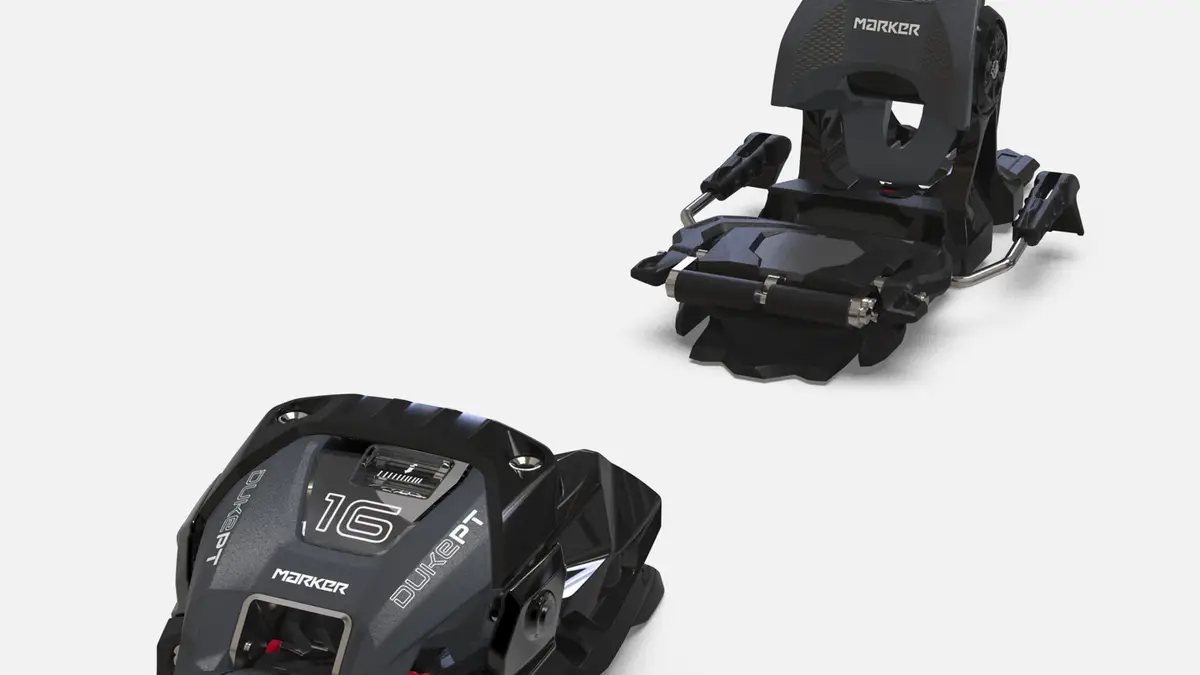
For the last decade, hybrid touring bindings have been trying to answer a deceptively simple question: how much downhill performance can be retained while still allowing a skier to tour uphill? The Marker Duke PT 16 takes a strong swing at answering that conundrum.
Essentially, the Duke PT 16 is a full alpine binding that conceals a pin toe setup and climbing bar. As with most things in life, there are tradeoffs. In this case, it’s weight. But for skiers who charge hard, those extra grams get you a downhill-oriented setup that feels like a conventional alpine clamp.
Marker Duke PT 16 Specs
- Stated Weight: 1,050g per binding in uphill mode / 1,350g per binding in downhill mode
- DIN Range: 6–16
- Brake Widths: 100mm, 125mm
- Heel Riser: 10°
- Stand Height: 24mm
- Heel Adjustment: 60mm
- Boot Compatibility: Alpine, AT, GripWalk
Design and Features
The Duke PT 16 has a 6-16 DIN range, a 24mm stand height and a substantial heel with plenty of elasticity. The binding accommodates Alpine, GripWalk and touring boot soles with BSLs from 240 to 360mm. Brakes come in a somewhat limited 100 and 125mm width. There is a lot of hardware, and it’s all there for a reason. Marker has essentially built an alpine binding that can shed part of its toe when it’s time to climb.
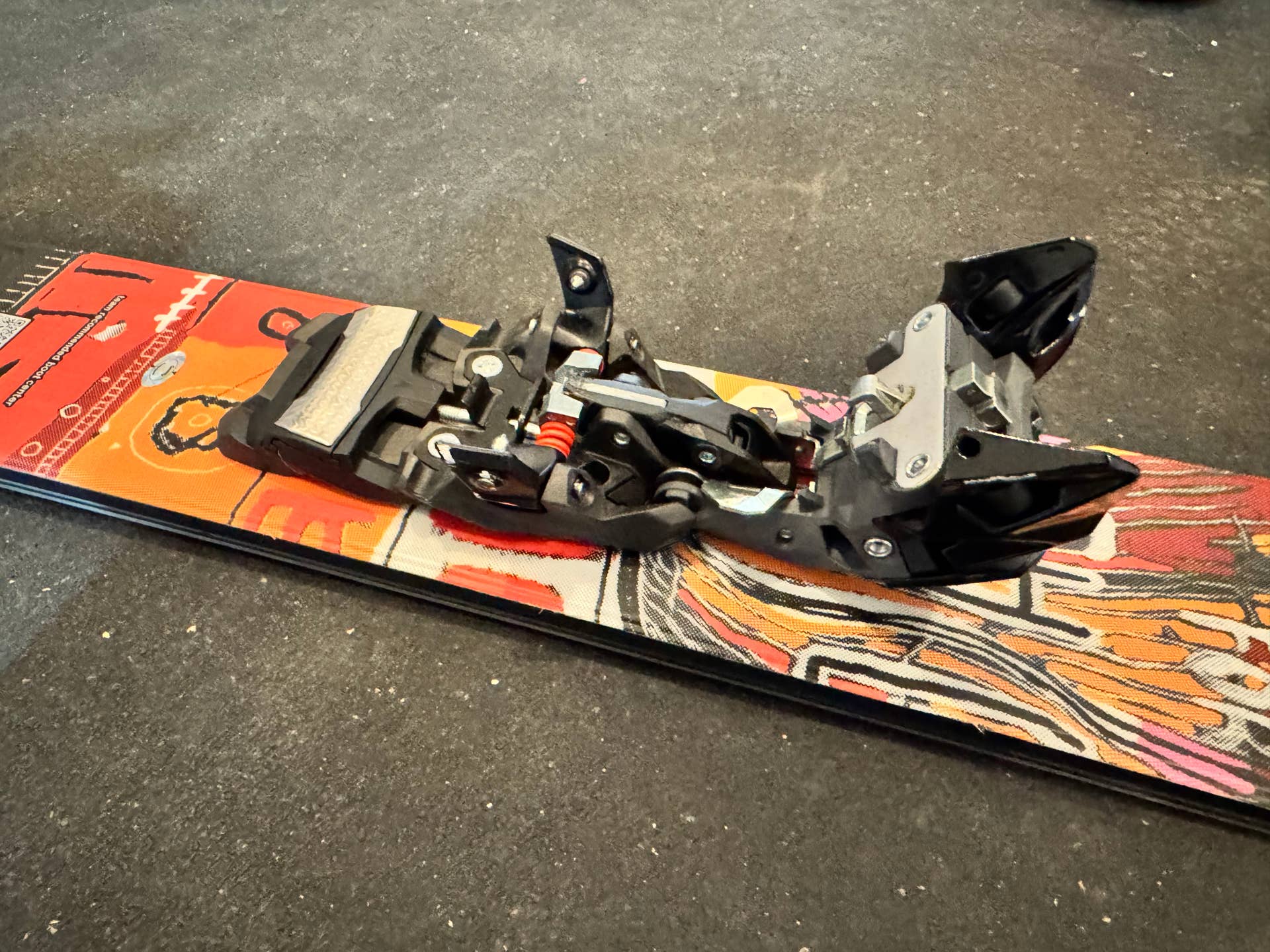
In touring mode, the upper portion of the toe swings forward revealing the tech pins underneath. You can choose to tour with it still attached and angled forward, or remove it completely and take 300 grams off each foot, but leaves you with a piece of binding hardware that shouldn’t be misplaced.
The heel’s brake locks into the up position for touring and incorporates a modest 10° climbing aid. That’s right, there are only two climbing positions: flat and a 10° lift when the climbing bar is raised.
Getting back into downhill mode requires putting the upper toe section back into place and locking it into the base unit. Once everything is seated, the setup is secure and ready for descent. When skiing, the heel allows the boot to move vertically under load while maintaining pressure against the binding, which is part of what gives the Duke its alpine-like feel.
One feature that’s a big plus is the metal bar on top of the toe piece that provides a convenient way to scrape ice from the bottom of your ski boot before stepping into the binding. It’s a small feature, but when you are standing on top of a puckering line, details matter.
View the 2 images of this gallery on the
original article
Downhill Performance
With the upper toe locked into place, the binding has the feel of a serious alpine setup. The 24mm stand height keeps the boot relatively close to the ski, while the substantial heel provides the support and elasticity expected from a high-DIN binding. Under aggressive skiing, the Duke transfers your energy quickly, resulting in a predictable feel, particularly compared to lighter tech touring bindings.
That weight difference is the whole reason for such a burly design. The Duke doesn’t ask you to accept a lightweight touring binding’s downhill characteristics in exchange for having pins. It puts a considerably more substantial binding under your boot and takes on the weight that comes with it.
There is also a psychological component to this type of binding. Skiers who spend a lot of time charging hard tend to rely on retention and elasticity characteristics. The way a binding responds when it gets fully loaded with the DIN screwed high is part of that familiarity and the Duke belongs in the top end of that world.
Uphill Performance
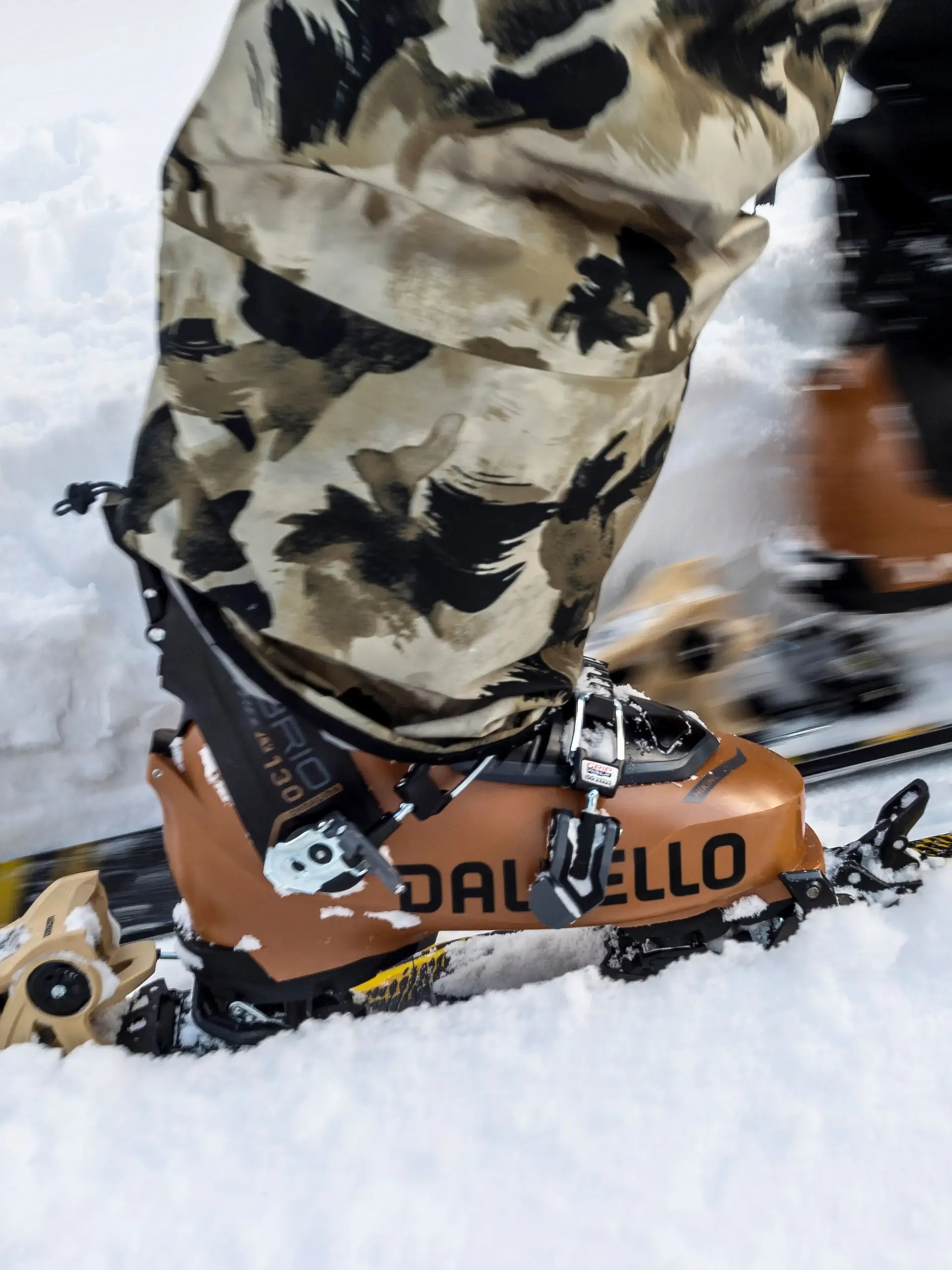
The weight of the Duke is the first thing you notice on the skintrack. Even with the upper toe section removed, 1,050 grams per binding is pretty hefty, especially compared to literally any tech setup ever made. On a long tour that added weight adds up, but removing the upper toe does make a meaningful difference. Three hundred grams per foot comes off the ski, and the remaining setup provides a fairly normal touring stride. The flat and 10° climbing positions cover most of the usual skintrack situations, but there are times when a higher climbing aid would be nice.
The Duke works best when uphill access is a means to an end. The design makes the most sense on shorter storm-day tours, sidecountry missions or more technical objectives where the descent is more important than minimizing every gram. If the goal is to cover enormous distances as efficiently as possible, there are better options.
The other consideration is transitions. It takes a while to transition this binding, because there is simply more to do. The upper toe has to be popped open or come completely off before touring and go back into place before skiing. And don’t forget that the removable component has to live somewhere safe while the skins are on. I’d suggest a dedicated place in your backpack. None of it is particularly difficult once the process becomes familiar, but it is more involved than most touring bindings.
Comparisons
The Duke PT 16 is competing directly with a small group of hybrid bindings aimed at skiers who want serious downhill performance with the ability to tour on the same setup.
The Tyrolia Attack Hybrid 14 is perhaps the closest comparison mechanically. It also uses a removable toe system that switches the binding between touring and alpine configurations. The Attack Hybrid is lighter and has a DIN range of 4-14, with a 9° climbing position. The basic philosophy is similar: accept more weight and complexity than a conventional tech binding in exchange for a more alpine-oriented downhill setup.
CAST Freetour is another direct competitor, but its modular design works differently. Instead of converting the toe itself, CAST uses a dedicated tech toe for climbing and a Look alpine toe piece and heel for the descent. The tech toe is swapped out when it is time to ski, leaving the skier with the familiar feel and release characteristics of a Look Pivot 15 or 18. For skiers already committed to the Look system, that’s a significant part of the appeal.
The Salomon/Atomic/Armada Shift2 16 takes a different approach to the same problem. The toe converts between touring and downhill configurations without requiring the skier to remove an upper toe section and carry it in a pack. At roughly 1,210 grams per binding, it is lighter than the Duke PT 16 in downhill mode, while its 8-16 DIN range puts it squarely in the same aggressive skier category.
While we haven’t tested it at POWDER, the new ATK HY is also worth comparing, mostly because it offers the same type of alpine performance at a small fraction of the weight.
Ultimately, these four bindings are chasing the same skier. The differences come down to weight, transition process, touring efficiency and the downhill binding platform itself. That last part can be more important than the spec sheet suggests. Hard-charging skiers often develop a strong preference for a particular brand’s binding system because they know how it feels and releases. A Marker skier may gravitate toward the Duke, while someone accustomed to Salomon, Tyrolia or Look may have a different preference.
There isn’t a universal winner here. The better choice is often the system that gives a skier the combination of touring function they need and the downhill binding characteristics they already trust.
Pros
- Excellent downhill performance for a touring binding
- 6-16 DIN range
- Substantial alpine-style construction
- 300-gram-per-foot weight reduction when the upper toe is removed
- Alpine, GripWalk and touring boot compatibility
- Built-in metal bar for clearing ice from the boot sole
Cons
- Heavy compared to dedicated tech bindings
- More complicated transitions
- When upper toe section is removed it must NOT be misplaced
- More hardware and moving parts than a conventional touring setup
Conclusion
The Duke PT 16 makes a compelling case for carrying extra weight uphill if downhill performance is the priority. It is considerably heavier and more complicated than a dedicated tech binding, but it also gives the skier a downhill platform that feels much closer to a conventional alpine binding.
The Duke is particularly appealing to skiers who spend most of their time chasing aggressive descents and want touring capability without changing the release characteristics of their trusted setup. For long approaches and weight-conscious missions, there are better tools. For getting uphill so you can ski ultra-aggressively on the way down, hit huge airs, tour to a backcountry jump, or just want to ski the resort hard with the capability to tour, the Duke PT 16 is one of the strongest options in the hybrid category.
PakarPBN
A Private Blog Network (PBN) is a collection of websites that are controlled by a single individual or organization and used primarily to build backlinks to a “money site” in order to influence its ranking in search engines such as Google. The core idea behind a PBN is based on the importance of backlinks in Google’s ranking algorithm. Since Google views backlinks as signals of authority and trust, some website owners attempt to artificially create these signals through a controlled network of sites.
In a typical PBN setup, the owner acquires expired or aged domains that already have existing authority, backlinks, and history. These domains are rebuilt with new content and hosted separately, often using different IP addresses, hosting providers, themes, and ownership details to make them appear unrelated. Within the content published on these sites, links are strategically placed that point to the main website the owner wants to rank higher. By doing this, the owner attempts to pass link equity (also known as “link juice”) from the PBN sites to the target website.
The purpose of a PBN is to give the impression that the target website is naturally earning links from multiple independent sources. If done effectively, this can temporarily improve keyword rankings, increase organic visibility, and drive more traffic from search results.
Streaming Film
Nonton Film gratis
Jasa Backlink
Download Anime Batch

Leave a Reply